Facebook advertising costs are increasing, while constantly changing algorithms cause many campaigns to “burn money” without achieving expected results. Entering 2026, optimizing Facebook Ads is no longer an option but a vital factor if you want to maintain profitability and scale sustainably. In this article, Optimal Agency will analyze the most effective how to optimize Facebook Ads costs according to new updates, from budget allocation mindsets and campaign structures to content and audience optimization, helping you spend less while still generating steady and stable orders.
Should you use ABO or CBO campaigns on Facebook in Q1/2026?
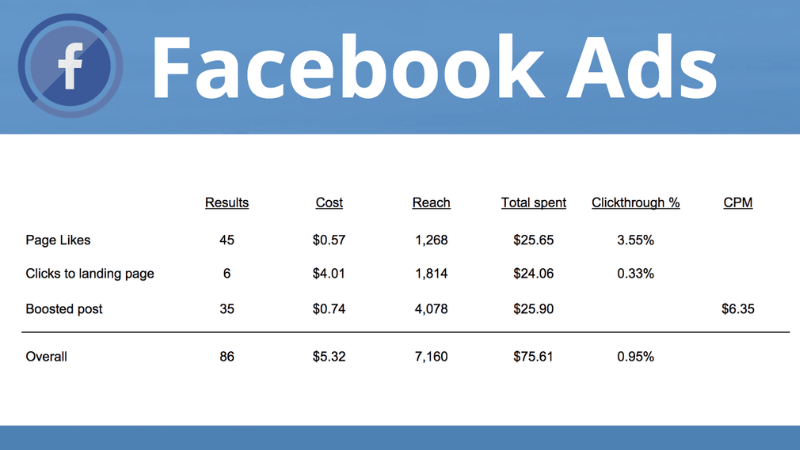
In the process of running Facebook Ads, one of the questions we receive most from you and other advertisers is: Should you use AVO or CBO to optimize effectiveness in 2026? In reality, there is no absolutely correct answer for every case. The choice between AVO or CBO depends heavily on your campaign goals, advertising stage, and current budget. Here is how we are practically applying them to help campaigns both optimize costs and scale easily.
Use AVO to test audiences and control spending
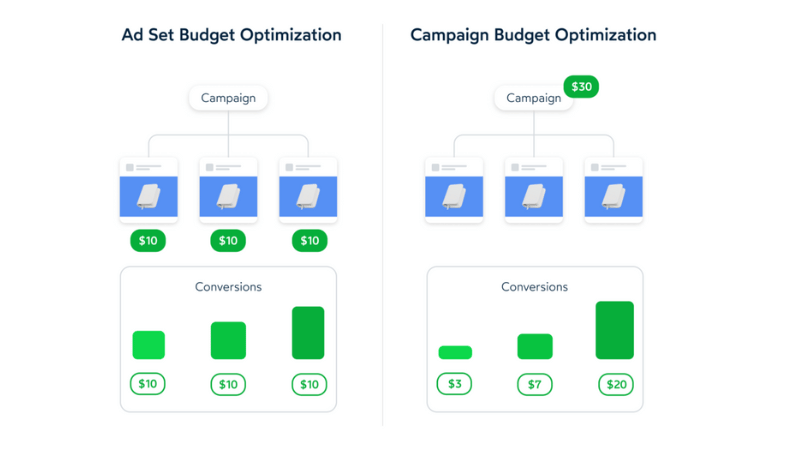
AVO is a form of setting the budget at the ad set level, allowing us and you to precisely control the amount spent on each audience group. This is the ideal choice when you are testing many different customer segments.
For example, if you have three ad sets, one running broadly, one with detailed interest targeting, and one for retargeting, AVO ensures each ad set is allocated an equal budget. As a result, we have enough data to evaluate which audience group brings the best CPA and which is the winning audience.
AVO is also particularly suitable when you want to strictly control the budget, such as only letting each ad set spend $20–$30 per day to test creatives or new markets. For short-term campaigns (e.g., 14–30 days) or when testing individual geographical areas (where each ad set is a different city or country), AVO helps limit the risk of unnecessary budget burning.
CBO reaches maximum effectiveness in 2026
CBO is a form of setting the budget at the campaign level and letting Meta automatically distribute the budget to the ad sets with the best performance. However, a crucial rule we always emphasize is to only use CBO after you have finished testing audiences. If you use CBO from the start without testing the audience, Facebook will pour the budget into the ad set with the best initial signals, leaving the remaining ad sets without enough data for evaluation. This easily leads to missing out on potential customer segments.
After identifying the winning audience using AVO, CBO becomes a powerful tool to test and optimize ad content. For example, you create three ad sets targeting the same proven audience, but each ad set uses a different group of creatives. Facebook will automatically push the budget into the ads that deliver the best results based on CPA, ROAS, frequency, and conversion quality. CBO is especially suitable for long-term or evergreen campaigns, where you keep the audience the same and continuously refresh content to maintain stable performance.
In practice, we almost always combine both AVO and CBO instead of choosing just one. For a local chiropractor clinic ad campaign, we start with AVO to test four different audience groups in the same area. Each ad set is given an equal budget to evaluate based on cost, reach, impressions, and lead quality. Once the most effective audience is identified, we create a new campaign using CBO, keeping only that winning audience. In the CBO campaign, we continue to expand by adding lookalikes or multiple ad sets with the same audience to test creatives. At this point, the goal is no longer finding the audience but optimizing content and scaling.
How much does a CBO ad campaign cost on Facebook?
When switching to CBO (Campaign Budget Optimization), many advertisers, especially beginners, often misunderstand how Facebook allocates the budget. We see many cases of “burning money” not because of a poor product or bad ads, but because the budget setup and number of ad sets are inappropriate. Here is how we and experienced advertisers view CBO costs more practically and effectively.
Understand how Facebook allocates budget in CBO
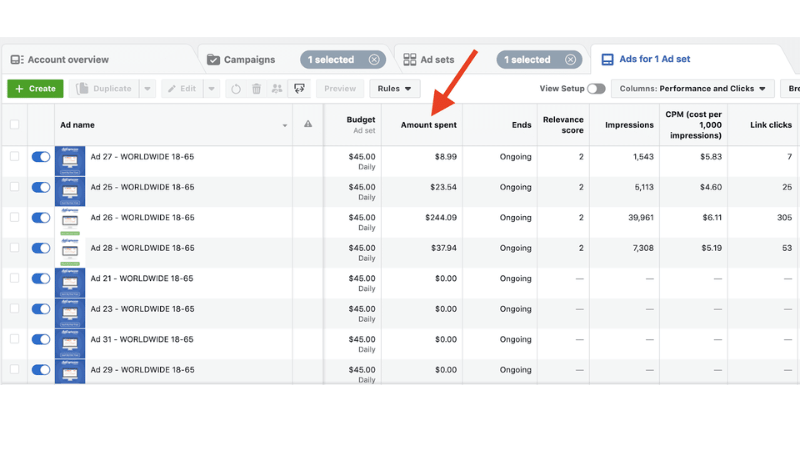
With CBO, the budget is set at the campaign level, and Facebook automatically distributes money to the internal ad sets. However, it is important to understand that most ad sets will spend a portion of the budget unless one ad set is truly superior and completely dominant.
This means if you add too many ad sets while the total budget is small, each ad set will receive very little money. Consequently, the algorithm lacks enough data to optimize, and the results are often poor. Therefore, we always advise balancing the number of ad sets and the total budget before turning on CBO.
CBO budget must align with product price and target CPA
If you sell a product for $250 and the target cost per order is $100, there is clearly no reason to run a CBO with 7 to 10 ad sets when the budget is only around $100 per day. In this case, running ABO or a simple campaign focused on ad optimization would be much more reasonable.
Conversely, if you have a larger budget, things become easier. When setting a budget of about $300 to $400 for a CBO, even with 7 to 8 ad sets, the system still has enough “room to perform” to find the effective ad set. This is why CBO usually works best when the budget is not too low.
Small budgets do not save you money as you think
A common mistake is thinking that a small budget allows for “safe testing.” In reality, it is the opposite. Facebook budgets are calculated daily, not by campaign total.
Even if you set $10 per day for 7 days, Meta evaluates effectiveness based on $10 per day, not the $70 total. With such low spending, the algorithm has almost no data to learn and optimize, leading to higher, not cheaper, costs per order.
How to test CBO when the average CPA is unknown
If you are using a new account and do not yet know the exact average cost per order, the safest way is to run a test CBO. We often recommend creating about 3 to 4 ads within a Sales campaign and setting a budget of approximately $100 per day. After a few days of running, you will begin to clearly see what your average CPA is. From that data, you will have a basis to decide whether to maintain the budget, increase the budget, or change the campaign structure.
How to optimize Facebook Ads costs effectively for CBO campaigns
In 2026, as Facebook prioritizes automation and machine learning, controlling costs in CBO campaigns no longer lies in “manual budget division” but in how we direct the algorithm’s distribution behavior. One method yielding great results is creating a “CBO within a CBO” by limiting the spending ratio of each ad set.
Create spending ratio limits for smarter CBO control
Instead of setting fixed monetary spend limits for each ad set, we use a daily maximum based on a percentage of the campaign budget. This is flexible and suitable for campaigns with large budgets or those that scale frequently. For example, if a CBO campaign has a budget of $3,000 per day and one ad set is performing very well, taking up 90% of the total budget, we would set a maximum percentage for that ad set at around 50–70% (60% is most common).
This means even if the campaign budget increases to $10,000 or $30,000 per day, that ad set cannot spend more than 60% of the total. This is much more effective than fixed monetary limits because it automatically scales with the budget without manual adjustments.
Why does CBO often “Gulp” budgets and increase costs?
Suppose you have 10 ad sets in a campaign with a $3,000/day budget. Facebook will quickly pour money into the ad set with the best signals, perhaps spending $1,000 or more, while others receive only tens or hundreds of dollars.
The problem occurs when you add new ad sets. Usually, a new ad set is not allocated an equal 10% as expected, but only receives $20–$40 per day unless it shows immediate superior performance. Over time, one ad set will always “win” and take 60–70% of the budget, making the campaign unbalanced and testing new creatives almost pointless.
Spending ratio limits help new ad sets get fair testing
Our solution is to set a maximum percentage for the strongest ad set, for example 50%. At that point, if the budget is 3,000 USD, this ad set can only spend a maximum of 1,500 USD. The remaining 1,500 USD will be allocated to other ad sets, including new ones.
This creates a fairer testing environment, where new ad sets have enough budget to prove their effectiveness instead of “failing prematurely” after only a few dozen dollars. More importantly, you do not need to interfere too much with the algorithm, but merely redirect the budget distribution.
A very important point that many advertisers misunderstand is that the maximum percentage does not force Facebook to spend that full amount. This is only a maximum limit. In reality, an ad set might only spend 30%, 15%, or even 0% if Facebook evaluates that it is no longer effective. This very flexibility makes the strategy safer and more sustainable. You simultaneously control the risk of one ad set “eating all the money” while maintaining the automated optimization power of CBO.
Currently, we are applying this strategy to many e-commerce, dropshipping, and lead generation accounts, especially during aggressive scaling phases. Initial results show that CPA is more stable, new creatives have the opportunity to be properly tested, and the entire campaign is less dependent on a single ad set. With the trend of large budgets and high competition in Q1/2026, this is a method that advertisers should consider applying early to better optimize costs and control risks in CBO campaigns.
To optimize Facebook Ads costs with CBO sustainably, advertisers and we need to control budget allocation instead of leaving it entirely to the algorithm. Setting spending limits by percentage helps maintain stable performance, creates fair testing opportunities for new ad sets, and avoids situations where an ad group “swallows” the entire budget. When applied correctly, CBO not only saves costs but also becomes an effective scaling tool for campaigns in 2026 and beyond.
Frequently Asked Questions
Businesses typically spend an average of $200 – $800 on Facebook ads per month. Depending on the business scale and advertising investment, a business might spend more than $800 or less than $200. Businesses can pay for more ad clicks, which can lead to more conversions from reach and higher revenue.
Running Facebook ads during peak hours helps increase ad visibility to target audiences, especially during times with high traffic. However, this is not necessarily an effective method for how to optimize Facebook Ads costs because of high competition from many ads targeting the same audience during those peak hours.


