A declined payment method on Facebook is no longer a simple issue of insufficient funds; it is an immediate financial integrity flag handled by Meta’s automated Llama-4 risk architecture. When a credit card or payment gateway is rejected, the AI system instantly downgrades the “Trust Score” of your entire advertising asset network. This recursive audit often locks connected ad accounts, business managers, and pages to mitigate cross-border payment fraud. To resolve this billing roadblock, advertisers must transition from manual card retries to a clean, isolated financial environment.
At Optimal, we isolate our clients from these global banking latencies. By replacing volatile personal credit lines with our stable agency-level infrastructure, global brands bypass automated fraud checks and maintain uninterrupted campaign velocity.
Parsing the 2026 Meta Billing Fraud Filters
Meta’s artificial intelligence updates have shifted the focus from “did the transaction settle?” to “where did the financial signal originate?”. If you receive a payment declined notification, your setup has likely triggered one of these three Llama-4 “Risk Hubs”:
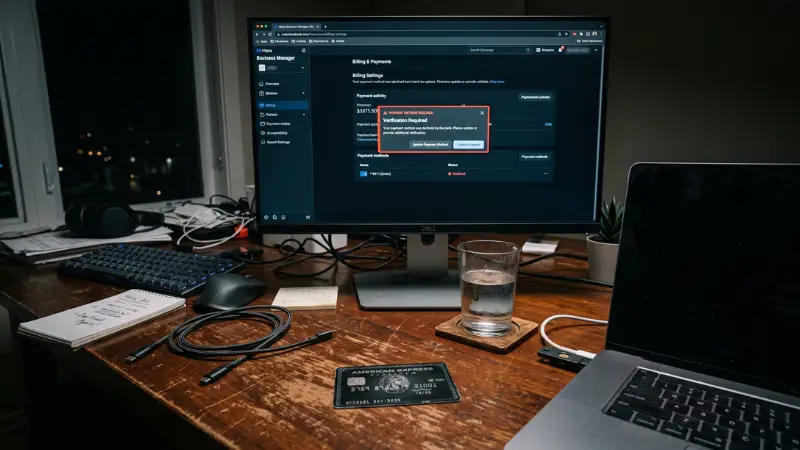
- BIN Contamination: Meta tracks the historical chargeback and ban rates of specific Bank Identification Numbers (BIN). If you use a common virtual card provider favored by low-trust actors, your card is flagged before the transaction even hits your bank.
- Geo-Location Mismatch: Accessing your Facebook Ads Manager account from an IP address in the United States while utilizing a credit card issued in Southeast Asia triggers a high-probability “Fraud Latency Check.”
- Debt Lineage Re-linking: Linking a payment method that shares even a partial string of text (such as cardholder name or billing address) with a previously disabled account causes an immediate system-wide rejection.
To decouple their scaling operations from these strict automated checks, successful enterprises are switching to whitelisted assets backed by tier-1 global banking institutions.
The 2026 Technical Settlement Protocol
Repeatedly clicking the “Pay Now” button after a decline guarantees a permanent lock on your Business Manager. Instead, execute this clinical synchronization sequence:

- Step 1: Financial Footprint Purge. Completely remove the flagged card from all active and restricted assets. Do not attempt to reuse this card identity on any Meta entity for 90 days.
- Step 2: Environmental Isolate. Open an anti-detect browser and route your connection through a dedicated residential proxy that matches the exact billing country of your new payment method.
- Step 3: Micro-Authorization Validation. Before uploading the card to your main campaign environment, verify it through Meta’s verification system using a fresh, historically trusted profile acting as a clean financial manager.
If your operational downtime is costing your business momentum, the fastest path to resuming traffic is to onboard with a whitelisted partner who can deploy pre-funded account structures instantly.
Eradicating Billing Risks with Agency Invoice Accounts

The only permanent solution to the “Payment Declined” loop in 2026 is moving away from post-pay or credit card-dependent models altogether. Relying on personal banking infrastructure leaves your business vulnerable to automated algorithmic mood swings.
By transitioning to renting Facebook professional ad accounts under an invoice line system, you eliminate payment friction:
- Line-of-Credit Funding: Campaigns are funded via direct agency wire transfers, completely eliminating credit card fraud audits.
- Zero Latency Spending: Scale your daily budgets past $20,000 without triggering “unusual activity” payment holds in your Facebook ads marketing agency environment.
- Meta Cleared Billing: Transactions are routed through verified agency lines that possess a permanent exemption from automated financial security checkpoints.
Frequently Asked Questions (FAQ)
Meta processes ad spend through decentralized global servers. If your domestic bank lacks advanced 3D-Secure 2.0 integration or blocks rapid international billing calls, Meta’s AI rejects the card instantly to prevent fraud.
In 2026, most virtual card apps are blacklisted due to shared BIN pools. Only credit cards issued by Tier-1 institutions or lines managed by a verified Facebook ad automation partner remain viable.
If you are running on a personal BM, your pixel data can be frozen along with the asset container. Moving your data layers into an Optimal agency structure insulates your pixel intelligence from localized billing failures.


