Facebook Ads measurements are increasingly playing a foundational role in helping businesses accurately determine where their budget is creating value and where it is leaking. In a context of continuously escalating advertising costs and increasingly stringent Facebook advertising policies, tracking the right metrics, reading data correctly, and linking advertising effectiveness to actual revenue has become a mandatory requirement, not an option. Facebook Ads measurements do not just stop at clicks or impressions; they encompass the entire conversion journey, cost per result, and return on investment (ROI), while ensuring advertising activities strictly comply with platform policies. In this content, join Optimal to explore how to build a methodical measurement system that helps businesses make decisions based on data instead of guesswork, thereby optimizing advertising performance sustainably.
Why ROI is important for businesses
ROI is not merely a financial indicator but also the foundation for businesses to evaluate operational efficiency, marketing, and growth strategies. Clearly understanding the role of ROI helps businesses avoid making decisions based on intuition while building a clear measurement system to optimize resources.
Evaluating investment efficiency
ROI allows businesses to look directly at the most important question: whether the money spent creates commensurate value. Instead of just looking at revenue or conversion volume, ROI reflects the direct relationship between cost and profit. Consequently, businesses can determine which activities bring real efficiency and which investments are consuming the budget without creating sustainable value.
Basis for budget allocation decisions
In a context where resources are always limited, ROI serves as a compass for budget allocation. By comparing ROI across marketing channels, campaigns, or products, businesses can prioritize investment in items that yield a higher rate of return. This helps reduce the risk of waste and ensures the budget is used with the right focus.
Risk control and cost optimization
Tracking ROI helps businesses early detect ineffective activities before costs spiral out of control. Regular ROI measurement facilitates timely strategy adjustments, cutting unnecessary expenses and optimizing operational processes. This is a crucial factor for maintaining long-term financial stability.
Measuring marketing strategy effectiveness
In marketing, ROI is the key benchmark for evaluating the success of a deployment strategy. A campaign with many reaches or interactions but low ROI still cannot be considered effective. ROI helps businesses directly link marketing results to business goals, thereby ensuring all communication activities are directed toward revenue and profit growth.
Foundation for sustainable growth
ROI not only reflects short-term results but also supports businesses in building long-term growth strategies. When ROI is tracked and analyzed correctly, businesses can clearly understand the customer lifecycle, the long-term value of each investment, and the ability to scale. This helps growth become not just fast, but also sustainable and controlled.
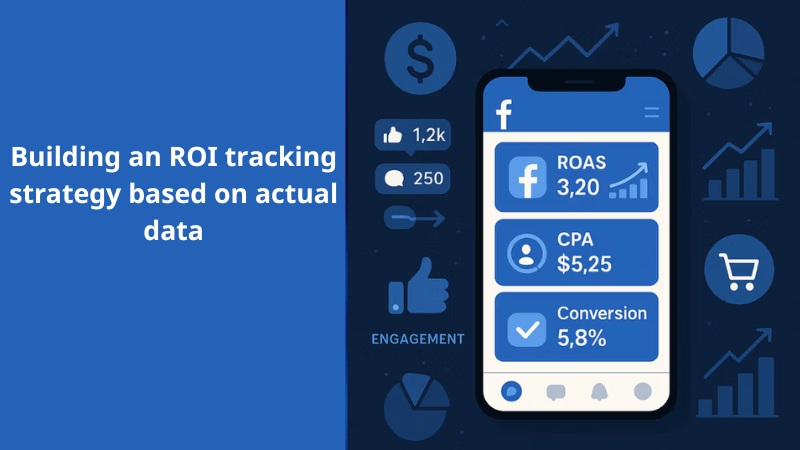
Building an ROI tracking strategy based on actual data
Tracking ROI does not stop at applying the right formula; more importantly, it is how businesses read, cross-reference, and interpret data arising from actual marketing activities. When ROI is placed in relation to costs, revenue, and specific business goals, this indicator truly reflects investment efficiency.
The concept of ROI
ROI (Return on Investment) is an indicator reflecting the profitability of an investment. The commonly used basic formula is: ROI (%) = (Net Profit / Investment Cost) x 100%.
This index shows how much net profit a business earns for every 1 unit of cost spent. A positive ROI indicates a profitable investment, while a negative ROI shows that costs exceed the value returned.
In a marketing context, ROI evaluates the effectiveness of communication, advertising, promotions, and customer acquisition campaigns.
ROI formula in marketing
For marketing, ROI is calculated using the formula: ROI = (Marketing Revenue – Marketing Cost) / Marketing Cost x 100%.
Marketing revenue needs to be determined based on sources that can be directly converted, such as orders from ads, leads converted into customers, or generated contract values. Marketing costs include the entire advertising budget, personnel costs, tools, platforms, and expenses directly related to deployment activities.
When applying this formula, it is crucial to unify the method of recording revenue and expenses. If revenue is under-recorded or expenses are not fully aggregated, the ROI will not accurately reflect actual performance, leading to biased decisions in budget allocation.
Tracking ROI based on actual data
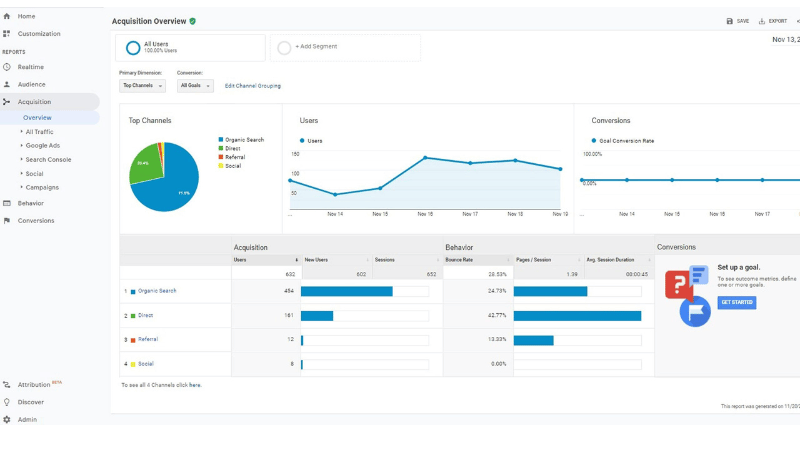
To track ROI close to reality, businesses need to connect data from various sources such as advertising platforms, sales systems, CRM, and analytical tools. Relying only on figures displayed on a single platform often fails to fully reflect the customer journey.
ROI needs to be tracked by stage, including the time costs are incurred, the time revenue is generated, and the payback period. This approach helps clearly distinguish between short-term efficiency and cumulative value.
ROI levels considered good by the sector
Each industry has its own specific cost characteristics, profit margins, and customer lifecycles; therefore, no fixed ROI threshold applies to every business model.
In general business, an ideal ROI ratio often mentioned is 5:1, which is equivalent to 20%. A positive ROI indicates that the business is profitable, while a 2:1 level merely reflects a break-even state, creating no room for growth.
For digital marketing, expectations are usually higher due to the ability for detailed measurement and continuous optimization. An ROI of 200% or more, equivalent to a 5:1 ratio, is typically considered effective and safe enough to expand the budget.
In the e-commerce sector, an ROI ranging from 20% to 30% is evaluated as positive. When it exceeds 30%, marketing activities are considered well-operated and capable of further scaling.
For financial services, the ROI is often significantly higher, ranging from 100% to 400%. This stems from the high customer lifetime value and the ability to reuse services over a long period.
In manufacturing and traditional business, common ROI levels typically fall within the 20% to 30% range. This level reflects a balance between investment costs, capital turnover speed, and stable profits.
Tracking ROI based on actual data
Build a unified data system instead of viewing results disparately on individual platforms. When shifting from a “viewing numbers” mindset to “reading data,” ROI is no longer a static figure but becomes a dynamic indicator of the health of all marketing and sales activities.
Tracking ROI based on actual data requires a synchronized connection between multiple sources, such as advertising platforms, websites, sales systems, CRM, and user behavior analysis tools. Every touchpoint in the customer journey generates valuable data, and only when these data points are linked can a business accurately understand where revenue originates, which campaigns truly contribute value, and which are merely indirect impacts. Relying solely on reports from a single advertising platform often leads to discrepancies, as these metrics do not fully reflect the customer’s decision-making process across multiple channels.
Furthermore, ROI needs to be tracked by stage rather than through instantaneous evaluation. Businesses must clearly separate the timing of cost occurrence, revenue generation, and the period required to break even.
This approach allows for the accurate identification of the short-term effectiveness of fast-conversion campaigns, while simultaneously measuring the cumulative value from long-cycle activities such as brand building, lead nurturing, or remarketing.
When ROI is placed within the context of a complete timeline and customer journey, businesses can make investment decisions based on real data rather than intuition or short-term expectations. This also serves as the foundation for optimizing budgets, allocating resources reasonably, and maintaining sustainable growth in the long term.
Evaluating ROI in relation to business goals
Each business, at different stages of development, will have different priorities: increasing revenue, expanding market share, growing new customer bases, improving retention rates, or optimizing profit margins. ROI is only truly meaningful when measured within the context of these objectives.
For a business in the market expansion stage, a low short-term ROI is not necessarily a negative signal. When the primary goal is to acquire new customers, build brand awareness, or establish consumer habits, marketing costs are often higher than the direct revenue generated.
In this case, the evaluation of ROI must be accompanied by supporting metrics such as the number of new customers, cost per acquisition (CPA), repeat purchase rate, or customer lifetime value (CLV). If a business only focuses on immediate ROI, it may cut activities that are building the foundation for long-term growth.
Conversely, for a business that has entered the profit optimization stage, ROI needs to be closely linked to actual profit margins and cash flow. At this point, a campaign with high revenue but significant operating, advertising, and logistics costs may yield a good nominal ROI but contribute little to net profit. The evaluation of ROI must reflect marketing’s contribution to overall financial goals, rather than stopping at generated revenue.
A common mistake is applying the same ROI standard to all campaigns, marketing channels, or business stages. In reality, each business objective entails a different interpretation of ROI.
Remarketing campaigns typically have a high ROI because they target groups with existing interest, while prospecting campaigns have a lower ROI but play a crucial role in expanding the user base. If a business only prioritizes high-ROI campaigns, it may inadvertently weaken its future growth potential.
In addition, ROI needs to be linked to non-financial goals such as customer experience, engagement levels, or audience quality. A campaign that brings in quick revenue but attracts a customer segment unsuitable for the product, leading to high return rates or excessive support costs, may produce a good ROI on the surface but place long-term pressure on operations and brand reputation. Evaluating ROI in relation to business goals helps businesses identify these latent risks.
Aligning ROI with business objectives also makes the decision-making process consistent and clearly oriented. When a business defines its priorities, ROI becomes a strategic support tool rather than an arbitrary metric.
Frequently Asked Questions
This discrepancy is often due to the attribution model. By default, Meta may count people who clicked an ad but later purchased through other channels toward its results. To track actual ROI in 2026, you need to use UTM codes combined with ERP software to reconcile unique order IDs between Meta and reality, eliminating ghost or canceled orders.
This is the “Vanity Metric Trap.” Meta may be distributing your ads to audience segments that engage easily but have no intention to buy. To track standard 2026 ROI, you must integrate the Conversions API to send data about actual order values and lead quality back to Meta.


