Almost any individual or business can deploy advertisements on Facebook, Instagram, and now Threads. However, not all industries operate under the same advertising mechanism. Due to strict regulations regarding Facebook privacy, fairness, and user protection, certain sectors are required to comply with more stringent requirements on how to define and reach their target audiences.
These sectors are classified by Facebook into Special Ad Categories, where audience targeting, ad delivery, and content control are subject to tighter oversight compared to standard ads. Failure to set the correct category from the start may result in restricted visibility or even risks affecting the entire advertising account. In the following section, let’s join Optimal to explore how to select special ad category Facebook, why this mechanism is applied, and how to choose correctly to ensure campaigns run stably, in compliance with policies, and sustainably in the long run.
What is a special ad category on Facebook?
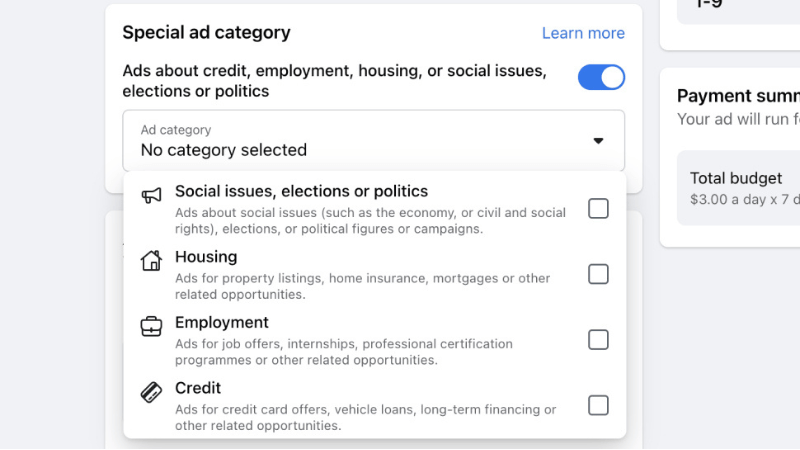
A Special Ad Category is an advertising control mechanism implemented by Meta for sensitive industries where fairness, privacy, and the potential for personal data misuse must be prioritized.
Unlike standard advertising, campaigns in this group must comply with stricter limitations regarding audience targeting and content distribution. To understand the essence of this mechanism, one must look at the concept, the reasons behind Facebook’s implementation, and the practical risks of incorrect setup.
A special ad category is Facebook’s way of requiring advertisers to proactively declare their industry when content relates to groups such as:
- Finance – Credit
- Employment
- Housing
- Social Issues, Elections, and Politics
Once a campaign is labeled under a special category, the system automatically adjusts the ad delivery, particularly in the targeting section.
The core purpose of this mechanism is not to create difficulties for advertisers but to limit discriminatory behavior or user manipulation. For example, in Employment ads, Facebook does not allow targeting by age, gender, or certain sensitive demographic factors to ensure all groups have equal access to job information.
Similarly, housing or credit ads, if targeted too specifically, could lead to the invisible exclusion of certain user groups, something Meta must control to meet legal requirements in many countries.
Why Facebook mandates classification

Mandatory classification is not merely a technical decision but stems from legal pressure and civil rights lawsuits over the years. In fact, Facebook has faced criticism for allowing advertisers to use behavioral and demographic data to “filter” audiences in recruitment, housing rentals, or financial service campaigns, leading to risks of discrimination.
Therefore, ad classification serves as the first layer of control for the system to identify the sensitivity of the content. When an advertiser declares the correct category, Facebook triggers appropriate restrictions, such as removing certain detailed interest options, narrowing demographic customization, and prioritizing delivery based on machine learning algorithms instead of manual targeting. This helps Facebook protect users, reduce legal risks for the platform, and compel advertisers to approach the market in a more transparent and sustainable manner.
Risks of incorrect selection or non-selection
Selecting the wrong category or intentionally failing to declare a Special Ad Category is one of the most common reasons for ad account issues. At a minor level, campaigns may suffer from restricted delivery, rejection, or remain in a prolonged “In Review” status. More severely, an ad account may be permanently restricted if the system detects repeated policy circumvention.
For instance, an employment campaign that does not select the “Employment” category might be initially approved but later re-scanned and flagged by the system. In such cases, not only is the current campaign stopped, but the violation history also damages the credibility of the entire account.
Similarly, real estate or credit ads that are not correctly declared may lead to restricted targeting permissions or additional verification requirements, disrupting media plans and incurring unnecessary costs.
Key special ad categories to note
Facebook applies special ad categories to sectors that directly affect user rights, opportunities, or major life decisions. When deploying ads in these groups, advertisers must declare the correct category at the campaign level and accept certain audience targeting limitations.
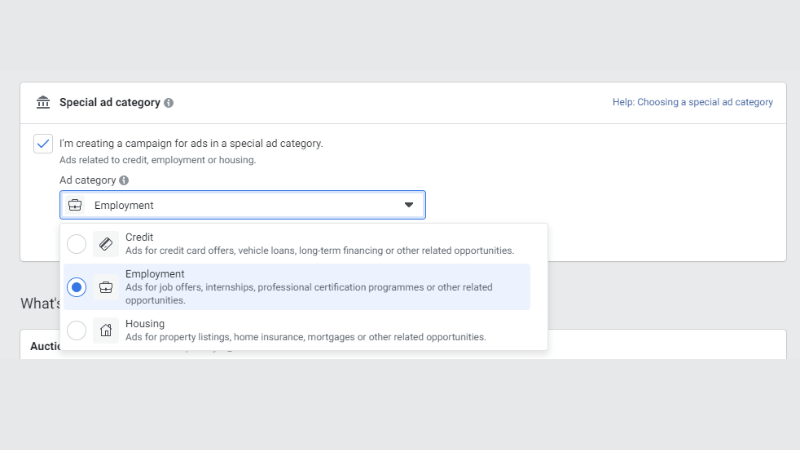
Credit and financial services
This category includes advertisements related to credit cards, loans, insurance, banking, investment, or personal and business financial services. Common examples include ads for credit card applications, consumer loans, auto loans, life insurance packages, or financial investment platforms.
When this category is selected, Facebook will restrict the ability to target by age, gender, income, or financial behavior. This is intended to prevent financial ads from reaching only a specific group of people, thereby reducing the risk of discrimination or the exploitation of user ignorance.
In practice, many banking or fintech ad accounts have experienced delivery restrictions due to failing to declare the correct category from the outset, even when the content itself does not violate any policies.
Employment and recruitment
Ads related to job opportunities, personnel recruitment, vocational training linked to employment, or job position announcements all fall into this group. For example, ads for “Sales Representative recruitment,” “IT Engineer recruitment,” or “Career opportunities at Company X” are mandatory to be categorized under the Employment Special Ad Category.
When this category is applied, Facebook removes many detailed targeting options such as age, gender, or certain interests. The goal is to ensure that recruitment information is distributed fairly, avoiding situations where specific groups are prioritized or excluded. Many small-scale recruiters have had their ads rejected for running recruitment campaigns as standard ads, leading to warnings or account restrictions.
Housing and real estate
The housing and real estate category applies to advertisements for the sale or rental of houses, apartments, land plots, real estate projects, or brokerage services. Examples include ads for selling condominiums, renting townhouses, launching new projects, or seeking long-term tenants, all of which fall into this group.
When correctly declared under this category, advertisers will be unable to target based on sensitive factors such as age, gender, marital status, or personal preferences. This ensures that all users have an equal opportunity to access housing information. In practice, many real estate accounts face delivery restrictions due to intentionally bypassing this category to maintain detailed targeting capabilities, only to be promptly detected and penalized by the system.
Social issues, elections, and politics
This is the most sensitive group within the Special Ad Categories, encompassing advertisements related to social issues, political opinions, elections, candidates, public policies, or topics that influence public perception. Examples include election campaigns, calls for policy support, social issue communications, or the activities of political organizations.
In addition to selecting the correct category, advertisers may also be required to complete an identity verification process and provide a funding source as required by Facebook. Advertisements in this group are typically subject to more rigorous review, longer approval times, and strictly controlled distribution. Many organizations have had their ads suspended simply because they failed to correctly declare the political or social nature of their content, even when the message was purely informational.
Frequently Asked Questions
Meta replaced traditional Lookalikes with Special Ad Audiences. However, this format is also being tightened. Instead of finding people based on personal characteristics, the algorithm finds individuals based on similar online behaviors without using prohibited demographic data. If you attempt to upload a phone number list to run a standard Lookalike for these categories, the system will immediately trigger an error.
To ensure fairness, Meta limits certain placements that could cause algorithmic bias. When selecting a special category, you often cannot manually choose individual placements but must use Advantage+ Placements. This allows Meta’s AI to automatically distribute ads where they can achieve the widest and fairest reach, preventing ads from concentrating on specific devices or platforms.


