Have you ever witnessed an ad account with a budget of thousands of dollars being “terminated” in an instant due to financial policy violations? Entering 2026, Meta’s AI algorithms have been upgraded to scan every comma and every credit score promise, making the execution of credit repair Ads Facebook campaigns a true challenge for advertisers. Old bypass tricks are no longer effective in the face of strict identity verification and strict ad “Special Meta Ad Category” control.
If you are struggling to find a way to maintain a sustainable presence for your services without being flagged, let’s explore with Optimal the absolute compliance roadmap and optimization techniques for credit repair Ads Facebook campaigns.
Details on credit repair on Facebook ads
Credit repair ads on Facebook fall under the sensitive financial services group, focusing on introducing solutions that help users improve credit scores and clean up negative credit histories. These ads typically appear when users exhibit behaviors related to researching loans, credit cards, overdue debt, or personal finance issues.

Objectives and audience
The central goal of credit repair advertising is to help users improve their credit profiles to qualify for mainstream financial products. In practice, many campaigns in this sector do not aim directly at “wiping out” bad credit history but focus on addressing factors dragging scores down, such as inaccurate information, paid debts that haven’t been updated, or credit disputes not resolved through proper procedures.
Service providers often build messages around the ability to help users reach the minimum credit score threshold required for personal loans, auto loans, or credit card approvals. High-converting ads usually link credit improvement to specific financial outcomes, such as accessing lower interest rates or avoiding application rejections when working with banks.
The target audience for credit repair ads primarily consists of individuals with poor credit histories or those facing difficulties accessing financial products. This group includes people who have missed payments, have bad debt, have been denied loans, or are in the process of rebuilding credit after a financial setback.
Another notable segment includes individuals with clear short-to-medium-term financial goals, such as buying a home, purchasing a car, or expanding a personal business. They are not just interested in improving their scores but also need a specific roadmap to meet lending criteria.
Campaigns targeting this group effectively often use orientational messaging, emphasizing the ability to prepare a solid credit profile before approaching banks or lenders.
Ad content
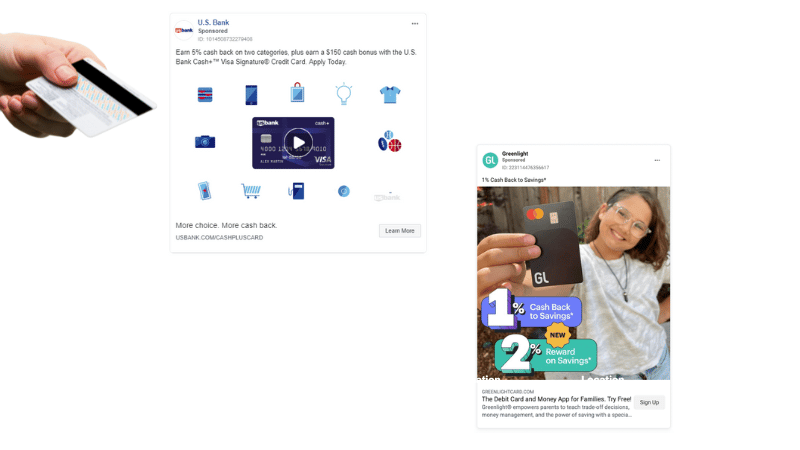
Credit repair ad content on Facebook is often structured to hit the “pain points” of the viewer. Phrases such as “erase bad debt,” “rebuild credit score,” “help getting a loan,” or “legal financial support” appear frequently, as these are problems users are actively trying to solve.
However, ads that comply well with Facebook policies typically avoid absolute commitment language, emphasizing instead the processes, methods, and experience in handling credit files.
Many effective campaigns choose data-driven presentations, such as the percentage of profiles improved over a certain period or the number of clients assisted in renegotiating with credit institutions. This helps the ad build trust while avoiding violations of financial services advertising regulations.
Additional services
In addition to core credit repair services, many entities integrate related financial, loan, credit solutions to increase value for customers. The most common are debt consolidation services, helping users combine multiple small debts into a single payment for easier management and reduced payment pressure. Some campaigns also mention support for debt settlement negotiations or building repayment plans tailored to personal cash flow.
Furthermore, providing credit management platforms or software is becoming a highlight in many current ads. These tools allow users to track credit scores, receive alerts for credit report changes, and receive guided steps to improve scores according to a roadmap. Ads linking credit repair services with financial management technology often carry higher credibility in the eyes of users.
Sustainable advertising 2026: Policy compliance is the key
Campaign sustainability depends directly on policy compliance. When labeled under the Special Ad Category (SAC), the system automatically limits certain sensitive targeting options to prevent discriminatory behavior, especially in areas related to finance, credit, and economic opportunity.
Accepting these limits does not reduce ad effectiveness if the campaign is structured correctly. Conversely, it is the foundation that helps the ad account operate stably, reducing the risk of ad rejection, ad set disablement, or even account bans.
Policies for this ad type
To deploy credit repair ads legitimately, one must first understand the policy framework Facebook sets for the financial ad group. This is not just a set of technical rules, but a control mechanism to protect end-users and mitigate legal risks for the platform.
Facebook categorizes credit repair ads under financial services, meaning campaigns must declare the SAC. Consequently, advertisers cannot arbitrarily filter audiences by age, gender, personal behavior, or factors that could lead to discrimination.
This explains why many accounts with healthy budgets still see poor performance when trying to “evade” SAC; the system perceives a high risk and reduces distribution. In reality, accounts that declare the correct category from the start typically see more stable review histories and significantly higher campaign longevity.
In many countries, particularly the United States, this activity is governed by specific laws, most notably:
- Credit Repair Organizations Act (CROA)
- Consumer protection laws
- Regulations against fraud and false advertising
Parallel to Facebook’s internal policies, credit repair ads are also governed by consumer protection laws and financial advertising regulations in each country. Using misleading language, promising guaranteed results, or implying the ability to “absolutely delete debt” can cause ads to be removed even after passing the initial review. In the long run, these violations not only kill campaigns but also affect the overall trust score of the ad account, leading to increasing distribution costs.
Precise targeting
When sensitive targeting options are restricted, many advertisers assume SAC reduces the ability to reach quality leads. In fact, the issue lies not in the limits but in building a targeting strategy that fits the policy framework.
Instead of relying on detailed demographics, sustainable campaigns focus on geography, context, and behaviors related to general financial needs. Broadening reach while controlling the message provides Facebook with enough data to optimize distribution.
Simultaneously ensuring the ad reaches those seeking credit solutions, SAC-compliant campaigns often achieve more stable CPMs after the machine learning phase, as the system evaluates them as low-risk ads. Prioritize geography first, as this is the strongest remaining targeting axis—in SAC, location is the primary weapon.
- Select countries/states/cities where your service performs well.
- Prioritize areas with:
- High financial demand
- Large populations for easy scaling
- Good lead history (if previously run)
Facebook heavily interprets data by geographic region. When the location is correct, the system easily finds groups with relevant financial behaviors, even without detailed selection.
Effective ad content
For credit repair ads, Facebook prioritizes messages that are educational, transparent, and solution-oriented rather than focused on result promises. An effective ad usually does not talk about “fast debt removal” or “increasing credit score in X days,” but emphasizes the process, experience, and long-term value the service provides.
This approach not only passes censorship more easily but also builds trust with users—a critical factor in the financial industry. When content is policy-compliant, campaigns tend to maintain stable performance, suffer fewer interruptions, and are easier to scale in budget over the long term.
- Clearer content regarding financial issues → Irrelevant users self-exclude.
- Orientational/educational messaging → Facebook understands the correct intent.
- No clickbait, no over-promising → The system evaluates the ad as safe.
In this scenario, even with broad targeting, leads remain “the right people” because only those with actual needs will respond.
Implementing credit repair Ads Facebook campaigns is no longer for those who prefer the “policy bypass” path or short-term tricks. The tightening by Meta’s AI and the strict regulations on the Special Ad Category serve as a natural filter, leaving only advertisers who truly invest in content quality and transparency. Success today is measured not only by the number of leads brought in, but also by account stability and brand reputation in the eyes of customers.
Frequently Asked Questions
Meta’s Advantage+ features often automatically crop images or change headlines to optimize clicks. However, in the credit repair industry, automatically pairing a “sensational” headline with an inappropriate image can trigger an immediate policy violation scan. When using Advantage+, lock content sections related to figures and promises. Only allow the AI to test color elements, button placements, or generic illustrative images to ensure the core message stays within the legal safety zone.
The credit repair industry is frequently reported by users if they do not achieving the desired results. Excessive reports will cause a Fanpage to suffer reduced engagement or an advertising ban. Build your “Community Reviews” section well. Proactively respond to all comments (including negative ones) professionally and transparently. In 2026, Meta highly values Fanpages with fast message response rates and regular community educational posts over pages that only post sales content.


