Executing high-volume user acquisition funnels for Web3, token launches, and decentralized finance (DeFi) decentralized applications (dApps) on Meta is an ongoing battle against algorithmic gatekeepers. Even when utilizing clean hardware and pristine connection lines, routing public traffic directly to a blockchain-interactive interface containing smart contract connect prompts triggers immediate policy rejections. Meta’s automated compliance crawlers apply a zero-tolerance policy to unauthorized crypto properties, systematically disabling associated business assets.
To maintain non-stop traffic delivery and secure continuous scaling, elite media buying operations deploy a two-tiered defensive frontend strategy: advanced server-side traffic filtering and synchronized intermediate destination routing.
This technical guide analyzes the mechanics of modern traffic filtering, highlights the top industry-standard crypto ad cloaking tools, and provides a blueprint for building high-trust safe-page frameworks Meta ads integration protocols.
The Anatomy of Server-Side Traffic Filtering: How Modern Stealth Frameworks Operate
Advanced traffic routing does not manipulate Meta’s internal systems; rather, it executes intelligent, real-time access control at your domain’s backend level. When a visitor requests access to your advertising destination URL, your server analyzes their connection metadata within milliseconds before delivering any visual assets.

The inbound traffic is programmatically segregated into two fundamentally distinct user personas:
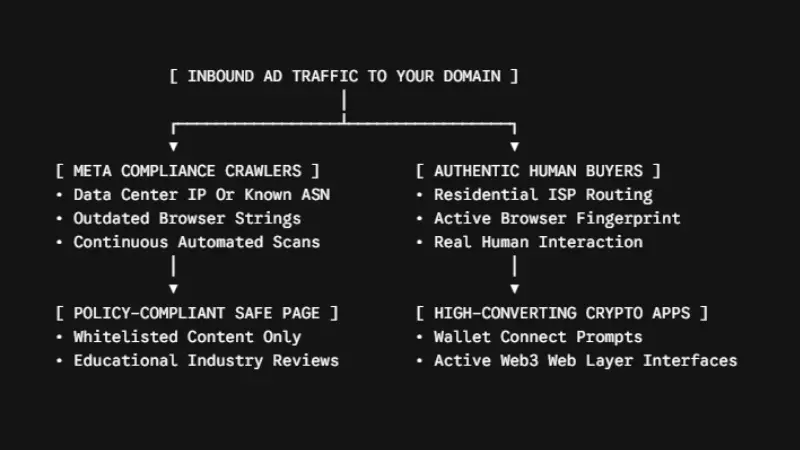
A. Compliance Bot Identification
Meta utilizes a dedicated fleet of server-side crawling agents to continuously audit landing page assets. These bots exhibit clear, automated footprints: they route through specific corporate data center ASNs, deploy highly standardized browser user-agent strings, and lack authentic human hardware interaction capabilities (such as localized mouse telemetry or device gyroscopic data).
B. Behavioral Redirection Execution
When a connection signature flags a crawling bot, the filtering script serves a fully sanitized, static, whitelisted educational page hosted natively on your primary domain. Conversely, when the connection exhibits real consumer behaviors—routing through verified local residential ISPs with active browser session fragments—the system reveals the high-converting cryptocurrency application interface.
Top Crypto Ad Cloaking Tools Preferred by Institutional Media Buying Team
Deploying a custom traffic filtering script is highly vulnerable to footprint leaks. Institutional operations utilize battle-tested, commercial-grade server-side filtering platforms that maintain dynamically updated blacklists of global platform checking nodes.
Keitaro Tracker
Keitaro is a highly adaptable self-hosted tracking utility favored for its profound server-side script control and database management capacities. Because it runs locally on your dedicated virtual private servers (VPS), Meta cannot map your tracking infrastructure signatures externally. It allows teams to write custom PHP redirection macros based on deep database parameters, including specific ASN blocking, local device orientation metrics, and custom geolocation parameters.
JZCloaker / Cloakit
These are cloud-based, specialized security applications engineered specifically for social media platform compliance isolation. They utilize high-performance cloud databases that continuously map newly deployed Meta auditing servers worldwide. Their deployment relies on a simple copy-paste integration code snippet placed natively within your index file, offering lightning-fast integration for multi-market funnels.
Blackhole V3
A premium, enterprise-grade traffic filter widely recognized among high-budget affiliate conglomerates. Blackhole utilizes proprietary machine-learning logic to analyze user connection velocity, pattern matching, and biometric input verification to identify hidden compliance inspection bots that fake retail consumer device parameters.
Designing High-Trust Safe-Page Frameworks Meta Ads Integration
A common technical point of failure occurs when the served safe page is designed poorly. If a crawler encounters a generic, single-paragraph placeholder page with zero outbound authority links or mismatched metadata, it triggers an immediate human manual review request.

An optimized safe page must behave like a high-end, independent media platform. Ensure your safe page architecture incorporates these structural requirements:
- Niche Context Correspondence: If your active ad creative promotes a Web3 asset utility, your safe page must present a highly professional, educational technology review or a long-form news editorial analyzing broader blockchain developments.
- Complete Corporate Structural Polish: The safe page domain must host active links pointing to a valid Privacy Policy, Terms of Service agreements, and accessible Corporate Contact data.
- Native Optimization Layouts: Utilize lightweight CSS structures and compress all internal media elements. Bots evaluate structural performance metrics; a safe page that lags or errors during loading raises immediate systemic warnings.
Mitigating Asset Vulnerability: Transitioning to Whitelisted Authority
While implementing state-of-the-art crypto ad cloaking tools paired with immaculate safe-page frameworks isolates your destination URL from direct compliance flags, running traffic through low-authority personal profiles remains highly volatile. Standard accounts operating within gray-hat or policy-adjacent spaces are subjected to aggressive automated velocity holds and sweeping manual evaluations.
To ensure long-term campaign survival and protect your optimization scaling pipelines, your underlying advertising asset architecture must possess baseline institutional authority.
The ultimate operational mitigation strategy involves integrating your advanced frontend stealth setups with specialized Facebook ads for crypto corporate agency accounts provided by trusted networks such as Optimal.to.
By upgrading your traffic pipeline to the corporate tier, your marketing engine gains fundamental operational security:
- Pre-Established Meta Trust Score: Rented accounts from Optimal.to are mapped natively under legacy Meta Partner Business Managers with massive historical compliance trust vectors. This baseline trust reduces the sensitivity of automated platform scans, allowing your ads to maintain steady delivery.
- Unrestricted Daily Capital Scalability: Bypassing standard account caps completely allows your media buying team to scale winning visual hooks aggressively without triggering structural velocity restrictions or sudden identity verifications.
- Rapid Asset Redundancy Deployment: If a macro platform compliance update impacts an active node, the engineering team at Optimal.to implements an immediate asset hot-swap—migrating your deposit balance and data lines to a fresh, active whitelisted corporate account within 15 minutes, neutralizing delivery down-time.
Stealth Frontend Architecture Deployment Checklist
Enforce this strict step-by-step verification protocol across your technical division prior to authorizing any live Web3 traffic distribution:
- [ ] Server-Side Integration Validation: Verify that your traffic filtering integration runs via local script inclusion (PHP/JS) rather than standard client-side API redirects to prevent Meta crawler discovery.
- [ ] Crawler SGE Simulator Audit: Test the active destination URL using multiple web crawling simulation environments to guarantee that data center connections serve the whitelisted safe page 100% of the time.
- [ ] Legal & Footer Compliance: Confirm that the safe page layout possesses fully active, readable links detailing standard privacy policies and company ownership data.
- [ ] Asset Tier Decoupling: Confirm that your frontend filtering infrastructure runs exclusively on top-tier whitelisted corporate logs to ensure structural scalability and campaign stability.


