The Facebook ads business is becoming a cornerstone that helps many brands maintain sustainable growth amid increasingly intense competition. With the ability to precisely target audiences based on behaviors, interests, and individual customer needs, Facebook ads businesses not only expand their buyer segments but also build a more stable sales system over time. However, to achieve maximum performance, advertisers need to clearly understand delivery mechanics, conversion signals, and campaign quality benchmarks.
Strategic foundation for businesses when implementing Facebook Ads
This is the stage of shaping the mindset, establishing the structure, and creating the foundation so every advertising decision is grounded. When foundational elements are prepared systematically, businesses significantly reduce budget waste while increasing the ability to maintain long-term performance stability.
Defining growth objectives for each business stage
Businesses need to divide their stages clearly:
- Market penetration
- Revenue expansion
- Profit consolidation
Each stage requires different advertising objectives to ensure a cohesive and focused execution.
The market penetration stage typically features low new-customer volume, unclear brand awareness, and limited organic search behavior. At this stage, growth goals should revolve around expanding reach, increasing traffic, and collecting initial behavioral signals to build baseline data.
When entering the revenue expansion stage, objectives should shift toward increasing high-quality sessions and driving conversions. This is when businesses measure indicators such as add-to-cart rate, checkout completion, or cost per customer.
In the profit consolidation stage, businesses must prioritize cost optimization, increasing order value, and reducing reliance on advertising budgets. Here, growth goals should focus on sustainability. Metrics like customer lifetime value and return rate become central.
Standardizing data systems and conversion signals
The data system is the core that enables smart campaign operations. Businesses must ensure that pixels, conversion API, and key events are properly set up, accurately captured, and not duplicated.
Clean data helps the delivery algorithm operate more precisely and reduces cost fluctuations. Additionally, conversion tracking accuracy must be validated at each stage to ensure all signals reflect real customer behavior on the landing page.
Defining the target audience
Instead of targeting overly broad segments, businesses need to analyze user behavior through session data, content views, engagement levels, and return rates. These insights reveal what customers care about and what they expect.
When targeting is based on real behaviors, audience segments become more consistent and aligned with the product. This is the foundation for shifting from mass reach to targeting groups with the highest purchase intent.
Evaluating product capability before investing budget
Any product or service must be validated for appeal, differentiating value, and competitiveness before scaling ad spend. Businesses can conduct small-scale tests to observe market response, session quality, and audience growth.
If the product lacks necessary appeal, scaling the budget will result in waste and distorted metrics. Investing early in analysis and product refinement builds a solid base for the revenue-expansion phase.
Establishing long-term performance measurement criteria
The measurement system must be designed to allow businesses to observe performance over time, not just day-to-day. Key metrics include:
- Cost per action: CPA, CPL, ROAS in real time.
- Session quality: Tracked most accurately via Google Analytics 4 (GA4).
Metrics like engagement time, session depth, and events per session appear under Engagement. - Bounce rate: GA4 provides Bounce Rate and Engagement Rate by page and by traffic source.
- Frequency: Tracked directly in Ads Manager per ad set.
- Conversion consistency: Monitored continuously using Meta Ads for Conversion Window and GA4 for Funnel Exploration.
Standardized long-term measurement allows businesses to detect efficiency declines early and adjust content or campaign structure accordingly. When measurement is consistent, it becomes easier to evaluate the impact of each budget decision and campaign stage.
Ad structures that drive breakthrough revenue
For a campaign to achieve significant growth, the ad structure must align with user behavior, market demand, and the account’s delivery capability.
Persuasive content aligned with the purchase journey
Ad content must accurately reflect the stage of awareness that the customer is going through.
In the initial stage, businesses need to create messages that clearly define the problem the customer is facing, using simple and memorable visuals to evoke attention. Once the customer is aware of the product, the content needs to shift to clarifying the core benefits, demonstrating differentiation, and providing trust points such as actual reviews or supporting data.
In the final stage, the message needs to be more strongly motivating through elements like warranty, post-purchase support, and fast response time. Designing content according to these layers helps the campaign approach customers naturally and minimizes user skip rate.
Audience segmentation
Segmenting audiences by their familiarity with the brand is key to improving delivery efficiency.
- Cold audiences are usually built from interests, behaviors, or lookalike audiences.
- Warm audiences Facebook ads include those who have watched videos, visited the page, or interacted with posts.
- Hot audiences are the group with strong conversion signals, like add to cart or form submission.
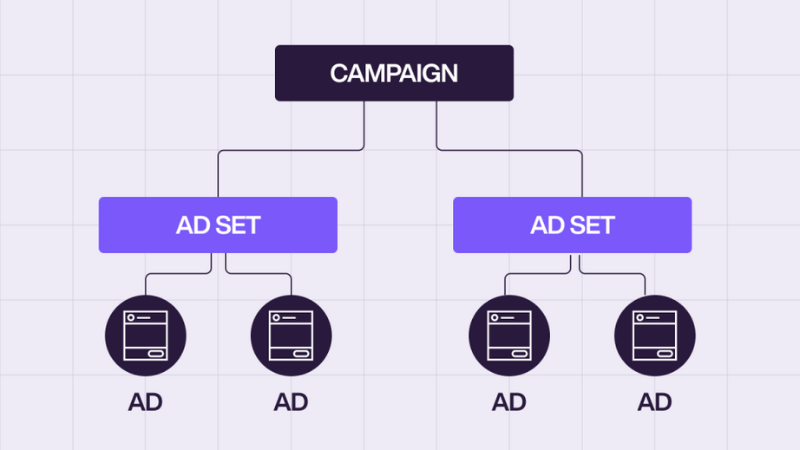
Businesses need to set up each of these groups in Ads Manager and create campaigns appropriate for each level of interest. With clear layering, the distribution system has a better ability to read behavior and allocate budget precisely instead of spreading it thin.
Budget allocation model for cost control
Budgets should be allocated based on the role of each audience group within the purchase journey.
- The broad reach stage should typically account for about one-third of the budget to generate enough data for the algorithm.
- Warm audiences require a moderate budget to maintain stable engagement.
- Hot audiences should be prioritized as this group brings direct conversion.
By tracking cost per session and cost per conversion, businesses can increase budget for effective groups and reduce spend for low-value ones. This model minimizes risk and increases overall campaign flexibility.
Creative variations
Any campaign can suffer from fatigue when users see the same content repeatedly. To counter this, businesses must prepare multiple variations of visuals, angles, copy, and layouts.
One main creative anchors the campaign, while supporting variations maintain freshness and distribute frequency. Every 7–10 days, part of the creative should be refreshed to prevent fatigue signals. This reduces bidding costs and improves reach to untapped segments.
Leverage appropriate ad formats
When aiming to introduce a new product, short videos or carousel formats help convey information quickly and generate interest.
If the goal is to drive traffic, simple images with a clear message are more suitable.
For products that need to prove value, collection or instant experience formats allow users to view multiple pieces of information without leaving the app.
Businesses need to test multiple formats within the same campaign to determine which is the most effective choice for each audience group. Combining multiple goal-appropriate formats helps the distribution system better grasp signals and generates a higher conversion rate.
Practical implementation by industry
To achieve real business growth, brands must apply structured, industry-specific execution. A one-size-fits-all formula will not deliver optimal results.
E-commerce
Online retail needs to prioritize a clear content set that leads from awareness to conversion. In the early stage, content should emphasize core benefits and reasons for product reliability.
When users transition to viewing pages or deep interaction, the system needs to activate content groups focused on providing value, such as comparisons, reviews from real buyers, or experience videos.
Hot audiences should be approached with more strongly motivating messages, focusing on reasonable prices, limited-time offers, or modular discounts by product group. For the budget, you can place a greater focus on the Hot Audience to optimize Cost Per Acquisition (CPA).
Education
The education model requires a longer decision-making cycle, so the content must be designed to deepen trust. The attraction phase focuses on learning pain points or skill upgrade needs.
Warm audiences need to be nurtured with short videos explaining the teaching methodology, real results, and student feedback.
In the hot audience group, content needs to demonstrate partnership, outcome commitments, and support during the learning process. Collection or instant experience formats are suitable because they allow for a comprehensive presentation of the curriculum.
Finance and Insurance
Industries related to finance require a high level of trustworthiness. The content set must revolve around transparency, data, and product safety. Cold audiences should be approached with messages clearly defining a financial problem or asset protection need.
Warm audiences require more in-depth content, such as simulated examples, real-life scenarios, or risk assessment guides. For Hot Audiences, the system should use concise creative variations to encourage contact, as the final decision is often made when the user feels sufficiently secure. The budget should be heavily focused on this group because each conversion is high-value.
Fashion
The fashion industry relies on visuals and emotional needs, so the content must express style, use environment, and the product’s applicability. In the approach stage, short videos or lookbook images create a strong impression. Warm audiences require content describing materials, the feeling of wearing, and customer feedback.
Hot audiences can be motivated by limiting factors such as new colors, short-term collections, or modular offers by product group. Creative variations need to change frequently to avoid decreased performance, as fashion users are easily susceptible to content saturation.
Services
The service industry needs to prove execution capability, so content must revolve around the work process, output results, and reliability. Cold audiences can be approached with content describing common problems.
Warm audiences require real examples or case studies demonstrating the solution process. Hot audiences need content that strongly encourages direct contact, focusing on the level of support and response time. Short videos or instant experience formats help users clearly understand the service quality before making a decision.
Real Estate
Advertising activity in real estate requires accuracy in targeting and coherence in guiding behavior, as the decision-making cycle is long and the transaction cost is high.
Businesses need to build a content set revolving around core values such as location, legal status, developer, utility system, and profit potential. Creative assets must convey trust points and competitive advantages, avoiding vague or exaggerated phrasing.
The user audience needs to be layered based on the actual level of interest.
- The cold group should be approached with exploratory content for the system to recognize initial interest.
- The warm group requires a higher level of detail regarding pricing, payment options, and project progress.
- For the very warm group, businesses can use content-providing capability, such as actual images, legal documents, or on-site experience.
Frequently Asked Questions
Low cost often comes with the risk of audience quality if the system spreads distribution too broadly to achieve a low price. These sessions tend to be short, have a high bounce rate, and rarely create conversion signals. Consequently, the system records many low-quality behavioral signals, leading to skewed retargeting efforts. Businesses need to monitor both price and session quality simultaneously to ensure that low cost does not cause long-term harm to the machine learning process.
A quality warm audience does not guarantee conversion if the message is not at the right touchpoint or the customer journey is interrupted. It could be that the user is interested but lacks sufficient reason to act, has not seen the product’s differentiation, or has had their demand diverted by competitors. Additionally, retargeting can easily suffer from ad fatigue if the frequency is too high, making users feel repetitive and lose interest. To improve, businesses need to refine the message according to specific behaviors, reduce saturation frequency, and create creative variations appropriate for the audience’s level of interest.


