Facebook Housing Ads are becoming a vital acquisition channel for real estate businesses and brokers. As buyer search behavior increasingly shifts toward digital platforms, implementing well-oriented advertising not only boosts lead generation but also optimizes marketing costs. However, Facebook housing ads are a specialized category of advertising with stringent controls regarding policies, audiences, and distribution methods.
Without a strategic implementation, accounts are highly susceptible to restrictions or diminished distribution efficiency. In this article, Optimal will provide an overview of Facebook housing ads, covering operating principles and policy requirements, as well as sustainable approaches, to help businesses build stable, secure ad systems that generate long-term, high-quality leads.
Facebook housing ads in 2026 from buyer demand
Advertising effectiveness directly depends on whether a business stays aligned with the actual needs of buyers: what they search for, what they expect, and when they decide.
Real estate search behavior
Homebuyers in 2026 no longer browse just “out of curiosity.” Most behaviors stem from very specific needs:
- Affordable pricing
- Convenient locations
- Clear legal status
- Mid-term residential or investment potential.
Facebook is not a traditional search engine, yet it acts as a trigger for search behavior thanks to its ability to personalize content based on user interests and previous interactions.
Evidence shows that users typically encounter housing ads passively at first, via their newsfeeds or short-form videos. After several touchpoints, they begin to proactively save posts, click for details, or submit their information.
This explains why Facebook housing ads campaigns must be structured as a continuous content sequence, rather than expecting a single ad to deliver immediate conversions.
Businesses that understand this multi-step search journey will gain a significant advantage in nurturing demand and controlling advertising costs.
Information expectations from ads
Today’s homebuyers do not accept generic, data-poor, or hyperbolic advertisements. Their primary expectation is clear, verifiable, and realistic information.
An effective housing advertisement does not require excessive flowery language but must answer core questions:
- Is the price authentic?
- What is the legal status?
- What is the construction progress?
- What are the incidental costs?
In the context of Facebook’s tightening housing policies, advertisements must be presented with transparency and neutrality. This inadvertently aligns with the 2026 buyer psychology: they trust ads that provide specific data over mere promises.
Businesses that invest in detailed content, authentic imagery, and frequent information updates will build higher credibility, thereby enhancing lead quality rather than just increasing lead quantity.
Home buying demand triggers
In real estate, demand usually arises from major life changes: getting married, having children, job changes, or reaching financial milestones.
Facebook holds a significant advantage in tracking these behavioral signals through content interactions, helping ads reach users precisely when they begin serious consideration.
Effective housing ads appear when buyers are actively comparing and evaluating options, rather than when they have no intent.
Therefore, maintaining an appropriate impression frequency, combined with remarketing and stage-based lead-nurturing content, is key. Businesses that patiently invest in the “not buying yet” stage are often those that reap the greatest benefits when demand truly peaks.
Why real estate remains a perfect fit for this platform

Real estate is a product with a long decision-making cycle, requiring buyers to encounter information multiple times before taking action—a requirement that Facebook meets exceptionally well.
Facebook possesses deep and continuous behavioral data, allowing housing ads to reach those in the consideration phase, even if they aren’t actively searching. Small interactions, such as watching a project video, reading a financial post, or engaging with family and investment content, serve as vital signals for the delivery system to refine targeting over time.
The platform supports various formats, from detailed articles and authentic imagery to short-form videos and consultation livestreams. This is ideal for real estate, a field requiring multi-layered information. Buyers can engage with a project at a very light level and gradually go deeper as their intent clarifies, without feeling “sold to.”
Facebook enables businesses to maintain long-term connections with prospects through remarketing and sequential content. Instead of relying on a single touchpoint, housing ads can accompany the buyer throughout their entire decision-making journey.
Setting up a policy-compliant Facebook housing campaign
Housing advertisements fall under the Special Ad Category – Housing; thus, the approach must be carefully constructed from conceptualization to technical setup. Rather than attempting to “bypass” targeting or using short-term hacks, the effective way is to design campaigns based on actual home-buying behavior, allowing Facebook to automatically distribute ads to high-intent users.
Step 1: Benchmarking ad prices against market standards
The starting point is not in Ads Manager, but in selecting the right price point for communication. Instead of picking an arbitrary “attractive” number, effectively use the average market price in the target area and adjust it slightly higher.
Example: If the average home price is $472,000, position the ad list at “Under $500,000.”
This gap is intentional. It allows the ad to simultaneously reach three high-conversion buyer groups: first-time buyers, area-shifters, and budget-conscious seekers who still expect quality. A price that is “above average but still within reach” always has a broader reach than extremes.
Step 2: Selecting high-perceived-value imagery
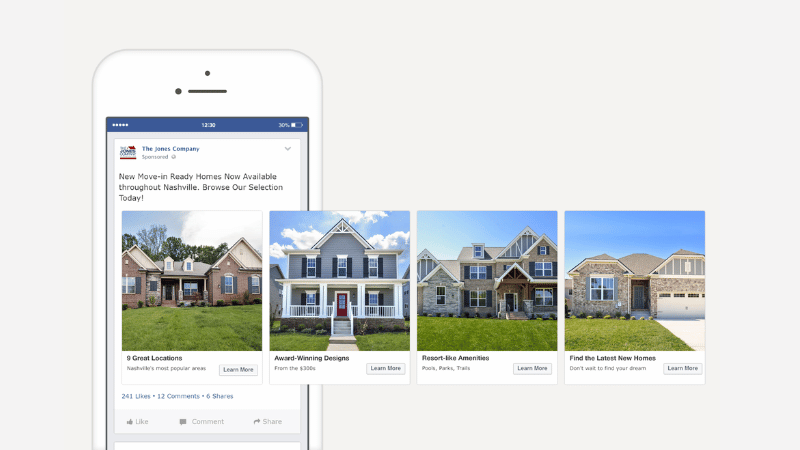
Visuals are the deciding factor in whether a user stops scrolling within the first 1–2 seconds. An advanced tip here is to use an image of a property valued slightly higher than the advertised price point.
For instance, when promoting a list of homes under $500,000, the featured image could be a property worth approximately $550,000. This image doesn’t explicitly claim the house is on the list, but it creates an implicit question in the viewer’s mind: ‘Is this home included in the list?’ This curiosity serves as the primary driver for them to click on the ad.
However, it is a mandatory requirement that the images must be from the local market, not sourced from Google or AI. Viewers need to instantly recognize the property as real estate within their target search area; otherwise, the advertisement will lose all credibility.
Step 3: Preparing the criteria-based listing link
Filtering the list must follow a clear principle: the maximum price should be approximately $50,000 above the market average, and the minimum price should be roughly $100,000 below it. This price range is broad enough to filter out low-quality units without pushing viewers toward properties that exceed their affordability.
Once filtered, the list should be sorted by popularity or view counts to ensure that users encounter the most attractive listings first. With the link ready, you have all the necessary ‘ingredients’ to proceed to Ads Manager.
Step 4: Setting up the lead campaign in Ads Manager
In Ads Manager, the advertising structure consists of three levels:
- Campaign
- Ad Set
- Ad
At the Campaign level, you should select Leads as your objective and opt for a Manual Leads Campaign to maintain full control. It is essential to use a clear campaign naming convention. For example, ‘Homes List Under 500K – Calgary’ to facilitate performance tracking and Facebook lead data downloads later on.
For the Housing category, Facebook automatically locks options such as age, gender, and narrow radius targeting. While this often causes concern, the Facebook algorithm has been exceptionally well-trained for this specific ad category. Once sufficient data is gathered, Facebook tends to distribute ads to the right high-intent audience, provided that the content and budget are properly configured.
Step 5: Budgeting, placements, and ad formats
The minimum budget should be set at $20/day, though $30/day is preferable to provide Facebook with sufficient data for machine learning. Underspending does not save money; it only prolongs the testing phase with ambiguous results. Always set a campaign end date to prevent forgetting to turn off the ads.
Regarding placements, the highest conversion rates for real estate are typically found on Facebook Feed, Instagram Feed, Profile Feed, and Marketplace.
At the Ad level, the single image format currently outperforms video because users scroll quickly and need to grasp information instantly. A 1:1 square aspect ratio is recommended to occupy more screen real estate on the feed.
Step 6: High-focus copywriting and Lead Form creation
The ad copy must clarify three key elements within the first few lines:
- Location
- Price Point
- Property Highlights
The CTA (Call to Action) should remain neutral, such as “Learn More.” When creating the Lead Form, prioritize the “Higher Intent” option to filter for higher-quality leads. Required fields should include Full Name, Email, and Phone Number, along with a Privacy Policy link from your website. The “Thank You” page should link directly to the pre-prepared housing list to ensure a seamless user experience.
Once the ad is published, monitoring and downloading leads from the Results tab, then importing them into a CRM for follow-up, is the crucial step to maximizing the campaign’s actual value.
Frequently Asked Questions
No, but transparent labeling is mandatory. In 2026, if you use overly polished 3D renderings without the “Computer-Generated Content” label, Meta may reject the ad for misleading buyers about the project’s actual status. However, the Instant Experience format integrated with 360-degree VR tours currently holds the highest quality scores, as it increases user dwell time, thereby reducing the cost per messaging conversation.
It is highly risky. Under the 2026 Data Privacy Laws, data files that are too old (over 2 years) without re-engagement are often flagged by Meta as “dead data” or of unknown origin. If you upload old phone lists without proper hashing (encryption) or lack of proof of consent, your account could be flagged for privacy violations. It is better to prioritize Lookalike Audiences (LAL) generated from fresh customers who have engaged within the last 180 days.


