Creating content for marketing campaigns on Facebook has never been a simple stroll. Amidst a sea of information crowding the News Feed, advertisers like us must constantly find ways to make the brand shine within the first few seconds. This is a challenge, yet it is also what turns every campaign into a creative playground full of potential. In this article, Optimal Agency will dissect the entire process of creating content for marketing campaigns on Facebook. If you want your ads to not just spend consistently, but actually generate sales, let’s start this journey.
How to create content for successful ad campaigns
When running Facebook ads, what advertisers always aim for is attention that is fast, concise, and clear. In an environment where users only spend a few seconds on each piece of content, simple ads that “strike the right nerve” will help you optimize the conversion rate without needing to produce complex videos or elaborate designs.
We will share three content formats that are delivering outstanding results. These are models we have successfully run in various campaigns, with a low Cost Per Action (CPA) and stable high ROAS. If you are looking for ways to create content that is fast, simple, yet powerful, these are the strategies we believe you can apply immediately.
Twitter style ads
In many direct VSL (Video Sales Letter) campaigns we run to generate leads and partnership requests, the Twitter-style ad format consistently ranks among the best performers. In a very recent example, we ran a “simulated” tweet ad and achieved a ROAS of 2.65x—far exceeding expectations for the simplicity it offered. The interesting part is: we simply wrote content in the tweet style, posted it to an Instagram Story, took a screenshot, and uploaded it to Ads Manager. No video, no fancy design, no effects. Just an image simulating a tweet interface, yet it made users stop and read. In practice, we tested two methods:
- Method 1: Write content on Twitter or X, post to Story, zoom in, take a screenshot, and run the ad from that image.
- Method 2: Use software like TweetHunter. You just paste the tweet URL, select a screenshot, convert the layout to the standard vertical Instagram format, adjust the background color and size, and download it.
Example: The ad “How to get more coaching clients? 1-2-3. Download the course today” resulted in a cost per appointment of only about $500 in a campaign for coaches with $5,000+/month revenue. The cost per new lead was under $10—very suitable for the new client acquisition funnel.
How to create content in the Twitter style:
- Look at content from other creators. If you see a post that makes you stop scrolling, take a screenshot.
- Input it into ChatGPT to rewrite in your own voice.
- Post on X, then transition to Instagram Story and save the image.
- Change the background color if you want multiple ad variations.
- Upload to Ads Manager and run immediately.
In a few minutes, you have 5–10 new ad samples to test.
Notes app style ads
Another “minimalist” ad format we really like is the Notes app-style ad. We were genuinely surprised to see this ad format deliver good lead quality with a stable cost of around $10. On the surface, this model is just a screenshot of the phone’s Notes app. But that very simplicity makes users feel like they are reading a personal note, reducing the feeling of being “sold to.” The content structure always follows 3 clear steps:
- Name the problem.
- State the result you can help the client achieve.
- Present the offer.
Example: “3 steps to increase your coaching bookings in 7 days,” accompanied by a free mini-course.
We often combine Notes static ads with video ads to increase trust, but for strong offers like a freebie or a mini-course, the static ad is enough to drive conversions.
When viewing the behavior history of those who booked an appointment, most saw the mini-course ad for the first time → entered the funnel → saw the Notes ad → booked.
How to create Notes app ads:
- Paste the content into the Notes app.
- Use the first line as the title.
- Use checkmarks instead of bullets to maintain the Notes style.
- Want to highlight text? Just change the background color of the text.
- Adjust the font size on a computer (Command + Shift + +/- will sync with the phone).
- Take a screenshot and save it.
- If you want a dark background version, turn on Dark Mode and take another shot.
In 3–5 minutes, you have at least 2 new ad samples.
Loom video ads
The third ad format that consistently delivers impressive results is the Loom video. The Loom video ad we recently ran achieved a ROAS of 4x, despite only being tested for a short time.
What makes this ad format effective is how it suggests a “live, real, intimate” feeling—like you are sharing your screen to instruct the client on something useful. In the latest sample, we recorded a video sharing 3 ways to increase the number of coaching clients: building trust, directing bookings via DM, and a familiar closing strategy.
We placed the Loom video in Canva, scaled it down, and added a headline and sub-headline to create a balanced layout. At the same time, we exploited viewer curiosity by mentioning the AI Booking Bot—an automated scheduling tool. This made the ad process clearer and more appealing: watch ads → bot schedules → you receive the appointment → close.
We will share a Canva template where you only need to change the headline, sub-headline, and insert the video in the middle, and you’re done. One version is dedicated to education, and one version pitches the mini-course offer directly.
Should you test Facebook ad creatives frequently?
When we work with you or other advertisers, this question almost always comes up: “Do I need to test creatives frequently?” And this is where we have to face a truth that no one likes, but cannot be ignored. Testing Facebook ad creatives is a mandatory task, like maintaining the engine so your campaign vehicle doesn’t stall halfway. Here is why frequent creative testing is so important:
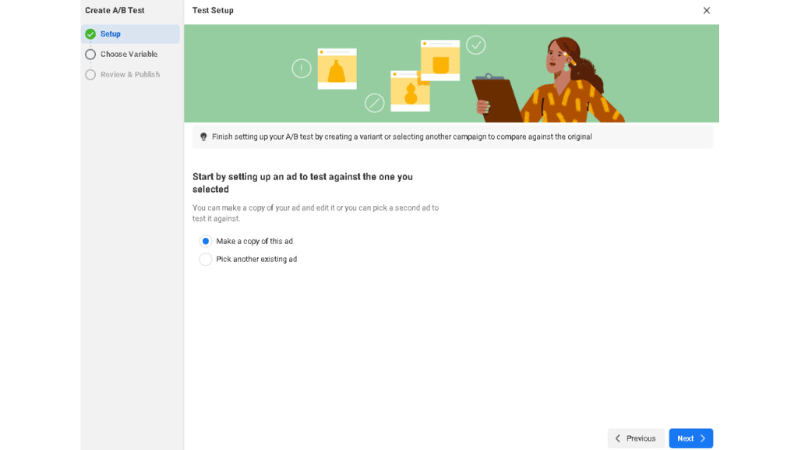
Creative burnout over time
No matter how good an ad is, even if it once delivered a low CPA that made you want to celebrate, it will gradually lose effectiveness. Viewers cannot remain interested in content that is repeated too often. Running for 1 month, 2 months, or 3 months without changing anything, you will see the cost per conversion increase significantly because the high display frequency causes viewers to become “jaded.”
We once ran a campaign for a cosmetics brand, a very strong video ad in the first week, but after only 4 weeks, the CTR dropped by 40% and the CPA nearly doubled. That is the classic sign of creative fatigue.
Creative testing deepens customer understanding
Every time you try different types of content—an honest review video, a storytelling UGC (User-Generated Content) format, a before-and-after image, or a customer testimonial—you will realize what truly touches the buyers’ emotions. Through the testing process, you will understand the most important question: What does my customer react most strongly to?
An ad that emphasizes a pain point, such as hair loss, is sometimes much more effective than one that talks about features. Conversely, for the technology industry, content describing specific benefits and real case studies often drives stronger orders. Testing is the way to find the “hidden” insight, which no tool can analyze for you.
Performance differences between ad creatives can be worlds apart
We once ran a campaign where one ad creative brought in orders at a cost of only $20. Assuming we had found the “light at the end of the tunnel,” we tested a few more creatives. And the results were surprising: for the same product, some creatives cost $40, $50, or even… $100 to generate one order.
The truth is, the creative is the factor that determines the majority of the Cost Per Conversion. Targeting, budget, or ad placement can be optimized to some extent, but if the creative is weak, the CPA will skyrocket uncontrollably. Therefore, you must always be on the journey to find the “winning ad.” And there is only one way to find it: test continuously, regularly, and strategically.
How to test creatives in Ads Manager: Tips for choosing suitable content for ad campaigns
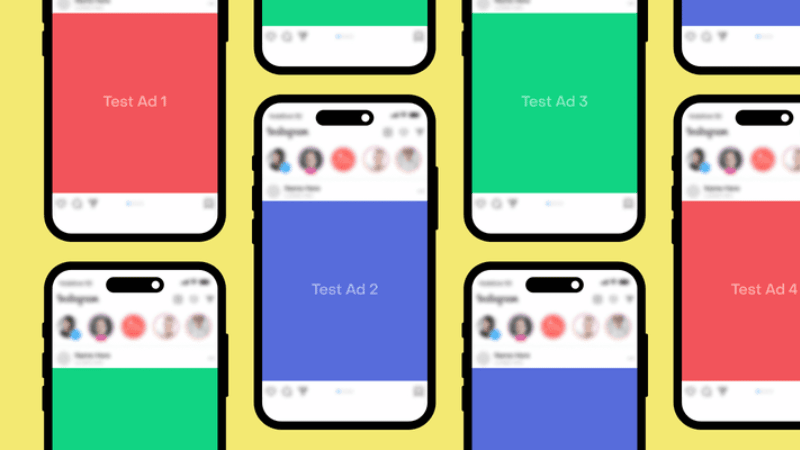
When running ads on Facebook, the creative is always the heart of every campaign. Whether you use broad or narrow targeting, Advantage Plus or traditional ad sets, it is the image, video, and message that determine whether users stop, click the ad, and eventually become customers.
If you have a limited budget or are just starting, it is highly likely that you only have one Advantage Plus campaign for the Sales objective. In this case, we usually advise you to put all new creatives directly into that campaign, unless you already have an “overpowered” ad. When there is a big winner, Facebook almost pours the entire budget into it and ignores all new ads. At this point, the best approach is to create a separate testing campaign. The testing campaign can be a new Advantage Plus campaign or a regular campaign with multiple ad sets for clearer grouping. A regular campaign is useful if you:
- Sell many different product lines.
- Want to experiment with different creative angles.
Example:
- One ad set only tests creatives with the “gift” angle.
- Another ad set only tests the angle “for busy mothers.”
Thanks to ad sets, you can easily control and compare different angle groups. Conversely, if your current Advantage Plus campaign does not have a “king creative” and Facebook distributes quite evenly, you can fully introduce new creatives there, let them run for a few days, and then analyze the effectiveness.
How to correctly analyze creative test results
Before analyzing, we want to emphasize: you should not only test videos. Although video is still great, static images are increasingly effective, easy to create, cheap, and extremely suitable for quickly testing multiple angles. We often combine both creative formats to see which type is most suitable for the product and target audience.
Key metrics when analyzing results
When viewing test results, we always look at the following key metrics:
Cost per Acquisition (CPA)
This metric determines whether the creative is worth keeping. We look at:
- Which creative brings the best-priced conversions?
- Which creative exceeds the acceptable CPA threshold?
Creatives with a good CPA are kept, and the rest are eliminated.
Video evaluation
If you are testing a video, check:
- Hook Rate (percentage of viewers in the first 3 seconds).
- Engagement Rate (level of viewing until near the end).
- CTR (click-through rate) to the website.
These metrics reflect what is working: a strong opening, engaging content, or an effective CTA (Call to Action). Note: You must manually add these columns in Ads Manager. We have detailed instructions on YouTube, which you can check when needed.
Static image evaluation
For static images, the analysis is much simpler. You only need:
- CPA
- CTR
If a static image has a high CTR and a good CPA, it is a strong creative.
Comparing Video vs. Static Image
After analyzing each type, we compare them:
- Which format delivers the lowest CPA?
- Is an image or a video more effective with the current customer group?
If you are new, we always recommend: test many static images first, because:
- Easy to produce.
- Quick to create variations.
- Can test many headlines and angles.
- Low cost.
- Clear results.
When you find a winning angle, you can convert that angle into a higher-quality video.
Turning test data into action
Once you find an ad that performs well, do not stop. This is the time to duplicate what is winning.
For video:
- Combine the best hook.
- Keep the body part that retains viewers best.
- Keep the CTA with the highest conversion rate.
- Create content for entirely new versions from the winning parts.
For static image:
- Good headline → create content for more variations.
- Good angle → deep dive into that angle.
- Which image has high CTR → duplicate, change background color, change layout.
Real-world example: A client of ours sells dog supplements. We tested two angles:
- The “disease prevention” angle.
- The “solving current health problems” angle.
The results were very clear:
- The prevention angle garnered almost no interest.
- The problem-solving angle had an extremely good CPA.
Immediately after, all ads were switched to the problem-solving angle, and ROAS increased sharply. This is the power of systematic creative testing in Ads Manager.
The act of creating content for marketing campaigns on Facebook is not just about writing a few lines or choosing an eye-catching image. It is a process where we combine customer understanding, storytelling skills, and optimization capability at every step. When the content targets the right person, the right need, and the right time, advertising becomes a bridge that connects the brand to the customer more naturally and effectively. We wish you success in building campaigns that are increasingly sharp and deliver deserving results!
Frequently Asked Questions
When running marketing campaigns on social media platforms, extensive coverage across many different platforms does not always yield the highest effectiveness. You might get better results by focusing on a few main social media channels that are suitable for your target audience. That is why you need to identify and research your target audience to know their favorite social media channels. Besides depending on the target audience, you can consider the type of product or service you are offering to choose the appropriate content distribution channel. Alternatively, you can rely on the performance analysis results of previous campaigns.
When developing promotional content for a marketing campaign, track the campaign through metrics in the measurement report. Focus on the measurement metrics you care about most, and track whether they are meeting the expected level. Check the performance of all your social media channels at least once a week. Additionally, you can determine the effectiveness of the campaign based on its objectives. Running A/B tests helps you understand what works and what doesn’t, and allows you to refine your content strategy.


